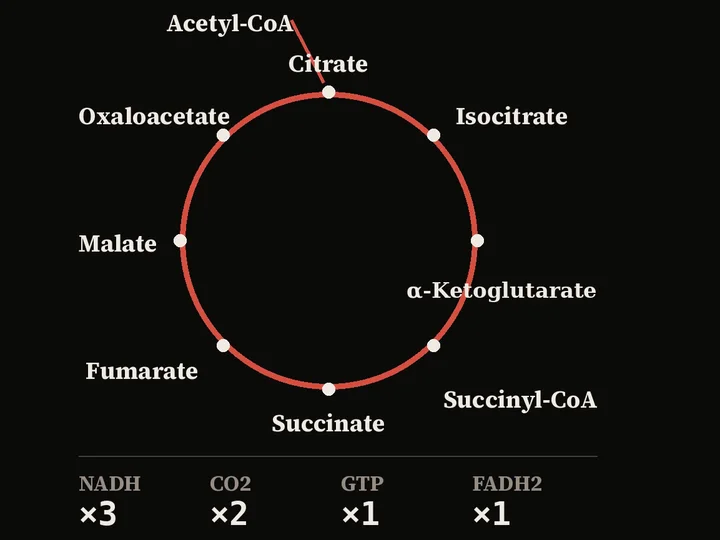
The Krebs cycle, every step3NADH per turn+ 1 FADH₂ · 1 GTP · 2 CO₂
405,943 views on our MCAT reels in the last 30 days · 104,657 on one Krebs cycle reel (Instagram insights, Oct 3 – Nov 2, 2026). Watch it →
Per turn, the Krebs cycle makes 3 NADH, 1 FADH₂, 1 GTP and 2 CO₂.
Acetyl-CoA brings in two carbons and two CO₂ leave on every turn, so the cycle itself is never used up. The three questions test what feeds it and what it cannot do.
During a prolonged fast, the liver oxidizes large amounts of fatty acids, yet humans cannot convert the carbons of even-chain fatty acids into a net gain of glucose. Which statement best explains this?
Pick one. The red pen does the rest.
The deciding linePyruvate dehydrogenase catalyzes an irreversible reaction, so acetyl-CoA cannot be converted back to pyruvate.
Why D: Gluconeogenesis needs pyruvate or oxaloacetate. Acetyl-CoA cannot become pyruvate, and feeding it into the citric acid cycle yields no net oxaloacetate, because two CO₂ leave for every two carbons that enter.
Why each choice fails
ADirection reversed: acetyl-CoA activates pyruvate carboxylase, signaling that oxaloacetate is needed; it does not inhibit it.
BTrue but beside the point: the fasting liver does turn acetyl-CoA into ketone bodies, but that does not explain why acetyl-CoA cannot yield net glucose.
CLook-alike terms: the glycerol backbone of triacylglycerols is gluconeogenic (glycerol 3-phosphate is oxidized to DHAP); it is the even-chain fatty acid carbons that cannot become net glucose.
DHolds: pyruvate dehydrogenase is irreversible, so acetyl-CoA cannot be turned back into pyruvate, and each acetyl group entering the cycle is matched by two CO₂ released, so no net oxaloacetate is left for gluconeogenesis.
Per molecule of glucose, how many NADH are produced by the conversion of pyruvate to acetyl-CoA and by the citric acid cycle together? (Each acetyl-CoA yields 3 NADH in the cycle, and each pyruvate gives 1 NADH when converted to acetyl-CoA.)
Pick one. The red pen does the rest.
The deciding lineOne glucose yields two pyruvate, each of which is converted to acetyl-CoA with one NADH and then oxidized in the citric acid cycle with three NADH, one FADH₂ and one GTP or ATP.
Why C: Two pyruvate per glucose: 2 × (1 + 3) = 8 NADH.
Why each choice fails
AOne step short: 2 counts only the pyruvate-to-acetyl-CoA step for one pyruvate; each glucose gives two pyruvate.
BOne step short: 6 is the citric acid cycle alone (2 acetyl-CoA × 3 NADH); the conversion of the two pyruvates adds 2 more.
CHolds: per glucose there are two pyruvate: 2 × 1 = 2 NADH from the conversion step and 2 × 3 = 6 NADH from the cycle; 2 + 6 = 8.
DWrong comparison: 10 adds the 2 NADH made in glycolysis, which the question excludes.
Mature human red blood cells have no mitochondria. Which of the following can they still do?
Pick one. The red pen does the rest.
The deciding lineGlycolysis takes place in the cytosol, whereas pyruvate oxidation, the citric acid cycle, β-oxidation of fatty acids and oxidative phosphorylation depend on mitochondria.
Why A: Only the cytosolic pathway remains: glycolysis, with lactate formation to regenerate NAD+.
Why each choice fails
AHolds: glycolysis occurs in the cytosol and needs no mitochondria; reducing pyruvate to lactate regenerates the NAD+ it needs.
BConditions ignored: oxidative phosphorylation takes place on the inner mitochondrial membrane, which these cells lack.
CRight effect, wrong mechanism: the citric acid cycle runs in the mitochondrial matrix, which is absent.
DLook-alike terms: β-oxidation takes place in the mitochondria (and peroxisomes), and its products feed the cycle and the chain.
If it isn’t helping, reply to your receipt email, or DM @redpenprep on Instagram within 30 days and get every dollar back. No questions asked. Email support