405,943 views on our MCAT reels in the last 30 days · 104,657 on one Krebs cycle reel (Instagram insights, Oct 3 – Nov 2, 2026). Watch it →
HF is over 10 billion times less acidic than HCl.
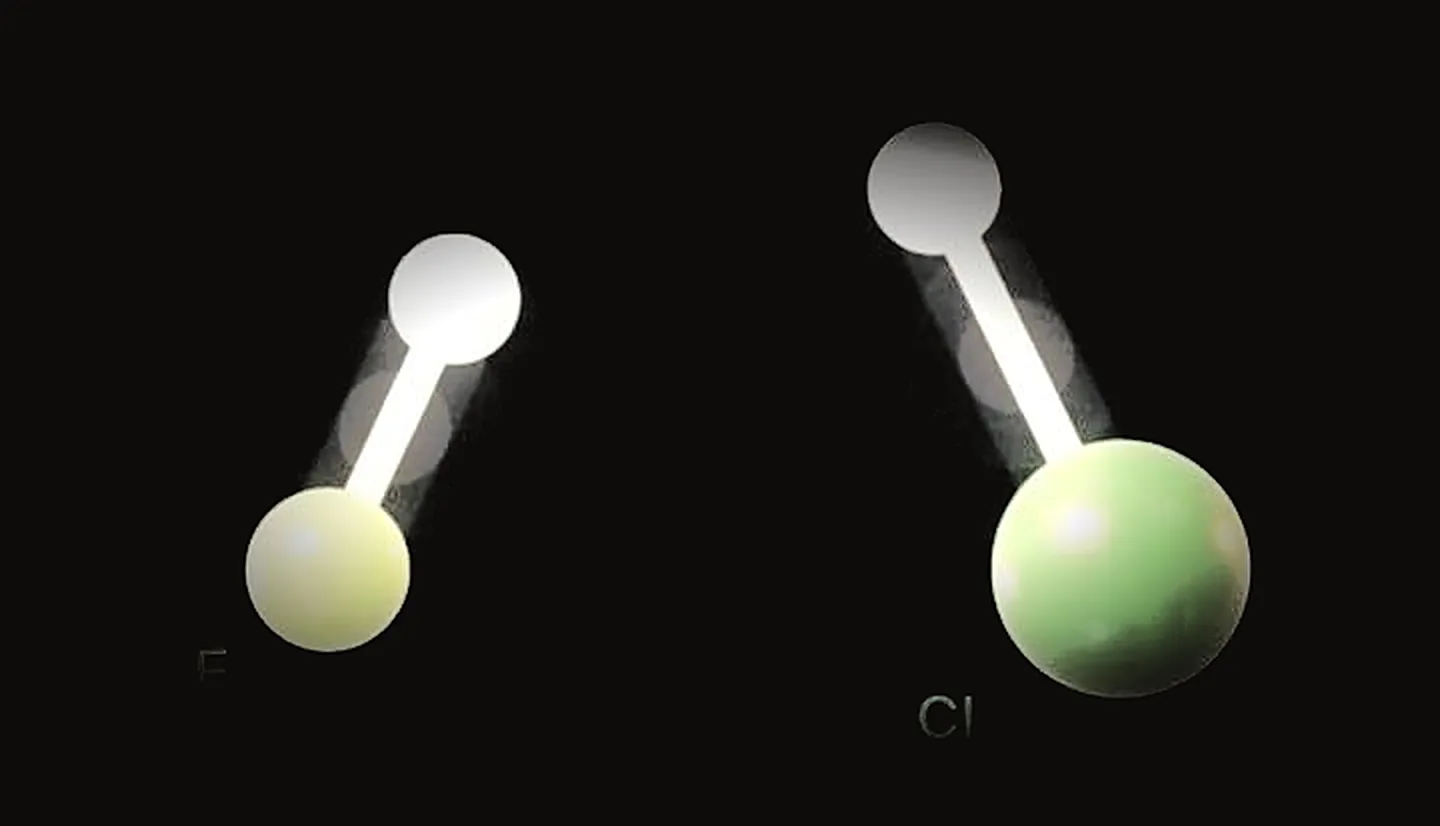
Down a group, size beats electronegativity. F− crams its −1 charge onto a tiny atom, Cl− has room to spread it, and the H–F bond is far harder to break.
The normal boiling points of the hydrogen halides are HF, 20 °C; HCl, −85 °C; HBr, −67 °C; and HI, −35 °C. Which statement accounts for both the rise from HCl to HI and the high boiling point of HF?
Pick one. The red pen does the rest.
The deciding lineLondon dispersion forces grow with the number of electrons and the polarizability of a molecule, and they dominate the attractions between larger molecules.
Why A: From HCl to HI the halogen grows and its electron cloud becomes more polarizable, so dispersion forces rise even as the H–X bond becomes less polar, and the boiling point climbs from −85 to −35 °C. HF, with H bonded to F, forms hydrogen bonds between molecules, which lift its boiling point to 20 °C, above even HI's.
Why each choice fails
AHolds: the rise tracks size and polarizability (dispersion), not bond polarity, and hydrogen bonds between HF molecules put HF above even HI.
BDirection reversed: bond polarity falls from HCl to HI as electronegativity falls (Cl 3.16, Br 2.96, I 2.66), so dipole–dipole attraction weakens; the rise comes from dispersion forces.
CLook-alike terms, covalent bond for intermolecular attraction: boiling separates HF molecules intact; no H–F bond breaks, and HF's high boiling point reflects the hydrogen bonds between molecules.
DRight effect, wrong mechanism, twice over: dipole–dipole attraction weakens from HCl to HI, and boiling breaks no covalent H–F bonds.
In methanol, which halide ion reacts fastest with bromomethane in an SN2 reaction?
Pick one. The red pen does the rest.
The deciding lineIn protic solvents, small anions are strongly solvated by hydrogen bonding, so nucleophilicity increases down the halogen group: I− > Br− > Cl− > F−.
Why C: Methanol hydrogen-bonds tightly to small, charge-dense F− and holds it back; I− is large and polarizable, weakly solvated, and reacts fastest.
Why each choice fails
AConditions ignored: F− is the strongest base, and in aprotic solvents it is a strong nucleophile, but in methanol it is the most heavily solvated and reacts slowest.
BOne step short: Cl− is in between on both counts; in a protic solvent the trend runs all the way to I−.
CHolds: in protic methanol, I− is the best nucleophile of the four.
DSays more than the data: equal charge does not mean equal reactivity; size, polarizability and solvation differ widely.
Average bond enthalpies are H–H, 436 kJ/mol; Cl–Cl, 243 kJ/mol; and H–Cl, 431 kJ/mol. What is ΔH for H₂(g) + Cl₂(g) → 2 HCl(g), estimated from these values?
Pick one. The red pen does the rest.
The deciding lineΔH ≈ Σ(bond enthalpies of bonds broken) − Σ(bond enthalpies of bonds formed).
If it isn’t helping, reply to your receipt email, or DM @redpenprep on Instagram within 30 days and get every dollar back. No questions asked. Email support